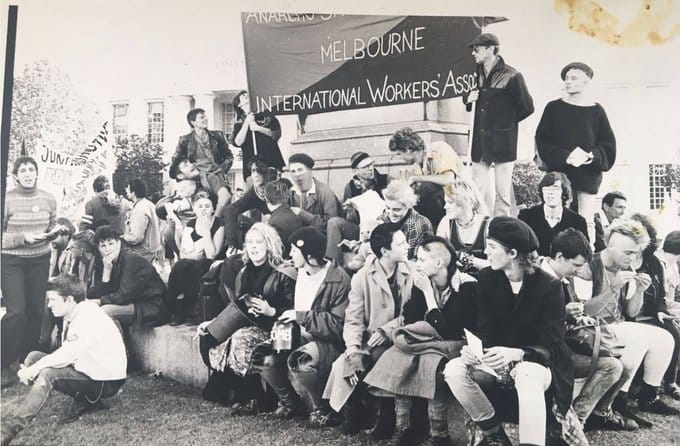
In the late afternoon on the 27th of January in 1986, in the upstairs meeting room at (the original premises of) Jura Books in King St., Newtown, the Anarcho-Syndicalist Federation (ASF) was founded. Thus began the most significant, impactful and effective organisation in the history of anarchism in Australia.
The genesis of the ASF can be traced back to the founding of the 'Sydney Anarchist Group' in 1956 by anarchist exiles from Bulgaria, former members of the Bulgarian Section of the IWA, CNT-B along with others in Sydney sympathetic to anarchism. Two of those involved, Georg Hristov and Alex Boneff, would be founding members of the ASF in 1986. Members of the Sydney Anarchist Group distributed a leaflet at the 1959 May Day march organised by the NSW Trades and Labour Council called 'Anarcho-Syndicalism'. An official of the NSWTLC gave a copy of the leaflet to the NSW Police and told them there were 'anarchists among the crowd".
Members of the Sydney Anarchist Group became involved with the 'Sydney Push' that grew out of the Freethought Society at Sydney University attracted by the interest in libertarian ideas. But there was not much about anarcho-syndicalism that interested the orbit of the Sydney Push that today would be recognised as an early form of radical Liberalism.
In December 1965, exiled members of the CNT-AIT established themselves in Melbourne as 'Grupo Cultural Estudios Sociales de Melbourne'. They took a different approach to the anarcho-syndicalists of the Sydney Anarchist Group who were focused on raising the awareness of anarcho-syndicalism among working people. The main focus of the CNT-AIT exiles in Melbourne was support and solidarity work for imprisoned anarchists founding the first Anarchist Black Cross (Cruz Negra Anarquista) in Australia in 1966 and the publication of texts in Spanish (later in English). But the CNT-AIT exiles were involved in the creation of what they regarded as working class defence infrastructure by which anarcho-syndicalism distinguishes itself consistent with its conception of unions as 'whole-of-class' and goes beyond the narrow definition of worker promulgated by reformist trade unions.
To this end, the CNT-AIT exiles in Melbourne were the initiators and among the founders of the Tenants Union of Victoria and the Fitzroy Legal Service. The view that the workers themselves were responsible for their own defence not only against the employers of labour, but also landlords and the police. This was entirely consistent with the anarcho-syndicalist practice of whole-of-working-class unions as opposed to the narrow confines of reformist craft, trade or even industrial unions.
Some of the CNT-AIT exiles were active in the 1973 Ford Broadmeadows strike. Over 1,500 predominantly migrant workers at the Ford plant in Melbourne engaged in a militant 10-week strike against unsafe, degrading, and high-pressure production line conditions. The revolt included a violent confrontation on June 13, 1973, where workers defied police and union leadership, resulting in smashed windows, pushing over a 30-meter section of the boundary wall, using hoses on offices, and fighting police with factory debris and food. The action succeeded in winning improved pay, better safety standards, and reduced production speed.
The 1970s saw an increased interest in anarchism among young people in Australia, particularly university students, and momentum built towards the foundation of an anarchist federation in Australia. The Federation of Australian Anarchists (FAA) was founded in January 1975, but with little input from the exiles. There was a current in the anarchist scene in Australia at the time that was deeply suspicious of collectivism as a potential threat to individual liberty and accompanied by a belief that any kind of organisation is inherently authoritarian. To assuage these concerns the FAA included individuals as equal in status to groups. This error contained the seeds of its demise. After the collapse of the FAA in July 1976, there appeared to be a split in the anarchist milieu in Australia; a current that was more concerned with questions of individual freedom and alternative lifestyles and a current that wanted to return anarchism to its working class origins. The advocates of anarchism as an alternative lifestyle were far more numerous.
In 1983, the Sydney IWW disbanded and reformed as the Rebel Worker Group (RWG) as a precursor to applying to the International Workers Association (IWA) as the Australian Section of the IWA. In 1983, a reading group called 'Melbourne Anarcho-Syndicalist Group' was founded. After the application of the RWG was rejected at the 1984 IWA Congress on the basis that they were only a single group, Antonio Jimenez, a stalwart of Jura Books, called for a Conference to be held to found an anarcho-syndicalist federation.
The ASF was founded on the basis of a provisional federation that was confirmed 1st ASF Congress held in Melbourne in January 1987.
At the 18th IWA Congress held in Bordeaux, France in April 1988, the ASF was admitted as the Australian Section of the IWA.
Through 2026, we will be publishing articles about the history of the ASF having completed its 40th year in existence. These articles will go into much greater detail and will draw on the archives of the ASF.
Anarcho-Syndicalist Federation 40th Anniversary
·
3 min read