
40th Anniversary of ASF-IWA
The Anarcho-Syndicalist Federation (ASF) seeks to replace all trade, craft and industrial unions who have no greater goal than to seek the best possible wages and conditions of work within the confines of a capitalist economy, with a class union, a union that organises all workers, future (students) or former (retirees), employed or not. A class union that seeks to organise those people who have no other choice but to sell their labour to live - working people. A class union that rejects the phony distinction that divides people into producers (workers) and consumers (community). The workers are the community are the workers. A class union that will not be satisfied with just a few extra crumbs from the tables of the ruling classes but aims to replace the government of people with the administration of things - a workers revolution made by the working people of the world.
The ASF seeks to build unions by a methodology that reflects and determines the kind of society that it has as its ultimate goal; a free and equal society. A society completely transformed from death cult capitalism to a society that acknowledges that everyone is entitled to all that the earth has to offer by right of birth alone. This methodology we call anarcho-syndicalism.
The ASF opposes the affiliation of unions, even those who reject revolution in favour of reform, to political parties. The nexus of the Australian Council of Trade Unions (ACTU) and the Australian Labor Party (ALP) have rendered all unions in Australia as nothing more than labour brokerage firms that act as launching pad for careers in politics. There is no such thing as a 'workers government'. Any working person who becomes part of the government ceases to be a worker to become a politician. Even if a union has no aim to rid the world of capitalism and wants no more than to get the best deal it can, it should be, at least, independent from the aims of political parties.
While ASF opposes the organisation of labour of Australia into ACTU-affiliated unions in favour of whole-of-class revolutionary unions, it has built a record of supporting workers in struggle, be they unionised into reformist unions or not, wherever it can to the best of its capacity. Even if the leadership of such unions, even the most militant, are ideologically opposed to anarcho-syndicalism, the ASF will support workers in struggle regardless.
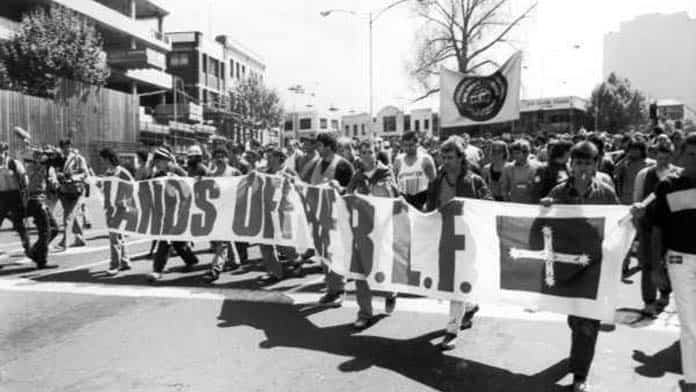
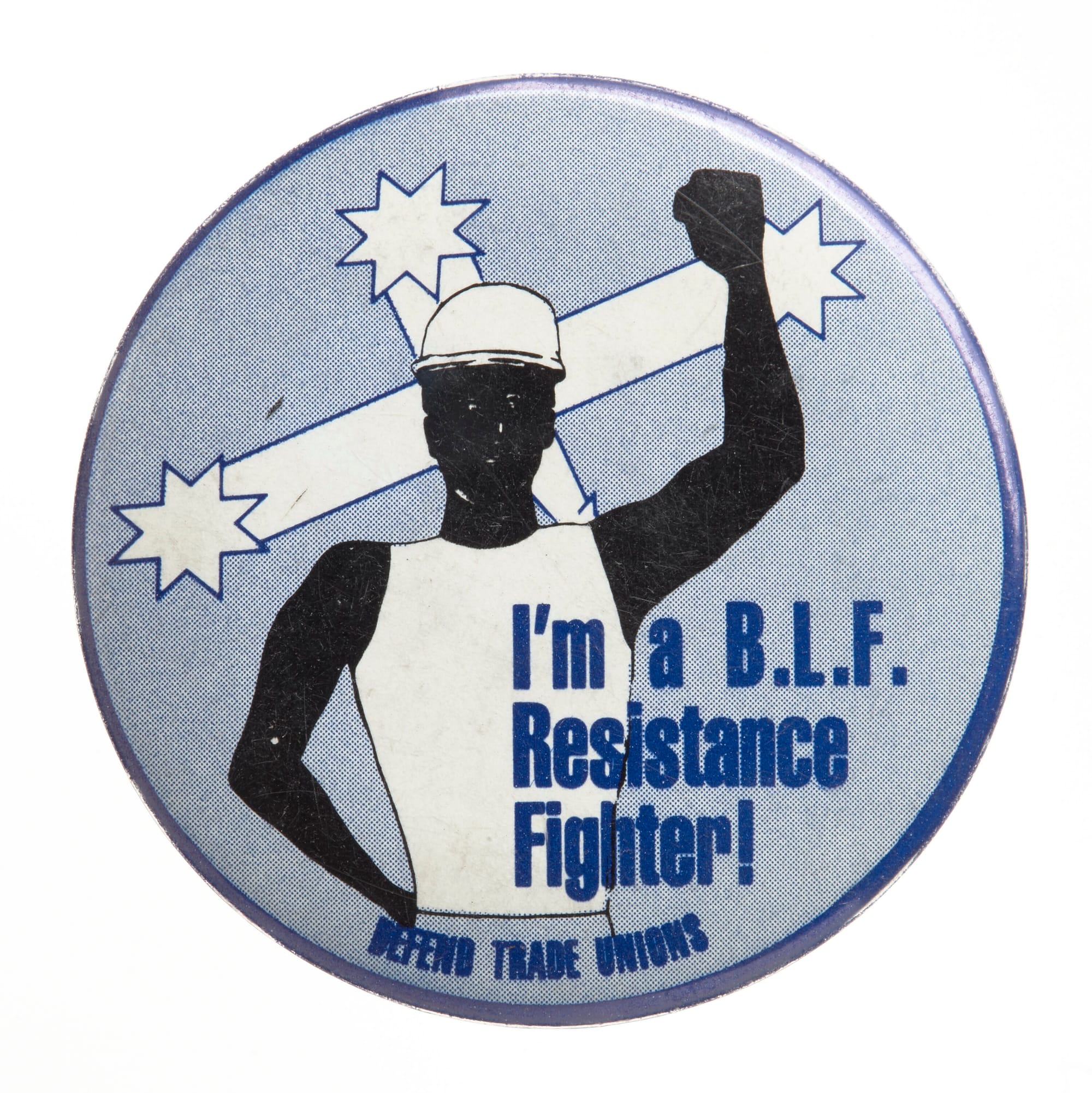
On 1 March 1986, veteran BLF organiser, Dave Kerin, attended the meeting of ASF Melbourne North. He reported on the plans by the State and Federal governments to deregister the BLF forcing their members to join either the Building Worker Industrial Union (BWIU) or the Federated Engine Drivers' and Fireman's Association (FEDFA). The BLF had been deregistered before in New South Wales in 1974 as a consequence of over 40 'green bans' that was the bane of property developers intent on making quick profits. The union was eventually re-registered in 1976 after other unions and the Australian Council of Trade Unions (ACTU) had campaigned for them but this time the ACTU had abandoned them and no other unions were prepared to help them. The BLF had committed the sin of refusing to sign on to the Hawke government's Prices and Incomes Accord ('the Accord'). The Accord was a deal brokered by the Federal Labor governments deal with unions who would agree to limit wage demands in exchange for increased social wage benefits, such as Medicare, superannuation, and tax cuts.
Having been abandoned by the reformist union movement, some in the BLF were looking for support elsewhere just as community organisations that were battling against property developers to protect parks and heritage sites had looked to the BLF for support. But, unfortunately for the BLF, very little support was forthcoming.
ASF Melbourne North had decided that they would support the right of the rank and file members of the BLF to join the union of their choice as this was consistent with the anarchist principle of voluntary association. ASF Melbourne North were in favour of breaking down the phony division between the workers union and the workers community. A division that was always emphasised by mainstream media whenever there was a strike or any kind of industrial action. This is consistent with the anarcho-syndicalist concept of union being comprised of the whole of the working class and that workers organisations should be concerned with workers struggles beyond the factory gate including those social issues that affect working people. As Pierre Monatte once wrote; "There is only one working class so there should be only one union".
ASF Melbourne North resolved to 'twin' with two BLF pickets; one at Queen Street and another at Banana Alley. Between April, when the Federal legislation deregistering the BLF was passed by Parliament and October, when the Victoria Police raided the BLF union office with 150 police and the site pickets were abandoned, the ASF Melbourne North stood with BLF members in defense of their rights. ASF Melbourne North not only provided the extra bodies to form the picket, fundraisers were organised to provide food and firewood to sustain the picket. It was this campaign of support by ASF Melbourne North that provided the template for future community support organisations such as Union Solidarity and future campaigns such at the Patricks dispute of 1998.
While it can be understood why reformist unions seek to be registered with the relevant government agencies, any union that is militant and effective will always be subject to the threat of deregistration as a means of the government controlling them. Workers organisations are only as strong as the community that is prepared to support them when needed.
Anarcho-syndicalism rejects any voluntary collaboration with the State as it does with employers. Anarcho-syndicalism advocates for complete independence of workers organisations from political parties who will always put the interests of the Party above those of union.
Real unions are not satisfied with the crumbs that fall from the bosses table, real unions must have the abolition of capitalism as its ultimate aim. Reformist unions are not much more than labour brokerage firms for the ruling classes. Real union are revolutionary.